Three-body problem
In physics, specifically classical mechanics, the three-body problem involves taking the initial positions and velocities (or momenta) of three point masses that orbit each other in space and calculating their subsequent trajectories using Newton's laws of motion and Newton's law of universal gravitation.[1] Unlike the two-body problem, the three-body problem has no general closed-form solution, meaning there is no equation that always solves it.[1] When three bodies orbit each other, the resulting dynamical system is chaotic for most initial conditions. Because there are no solvable equations for most three-body systems, the only way to predict the motions of the bodies is to estimate them using numerical methods.
Restricted three-body problem
In the restricted three-body problem, a body of negligible mass (the "planetoid") moves under the influence of two massive bodies. Having negligible mass, the planetoid exerts force on the two massive bodies that may be neglected; therefore the resulting system can be analyzed and described as a two-body motion problem.[3][5][failed verification] With respect to a rotating reference frame, the two co-orbiting bodies are stationary, and the third can be stationary as well at the Lagrangian points, or move around them, for instance on a horseshoe orbit. It can be useful to consider the effective potential. Usually this two-body motion is taken to consist of circular orbits around the center of mass, and the planetoid is assumed to move in the plane defined by the circular orbits. The restricted three-body problem is easier to analyze theoretically than the full problem. It is of practical interest as well since it accurately describes many real-world problems, the most important example being the Earth–Moon–Sun system. For these reasons, it has occupied an important role in the historical development of the three-body problem.[6]
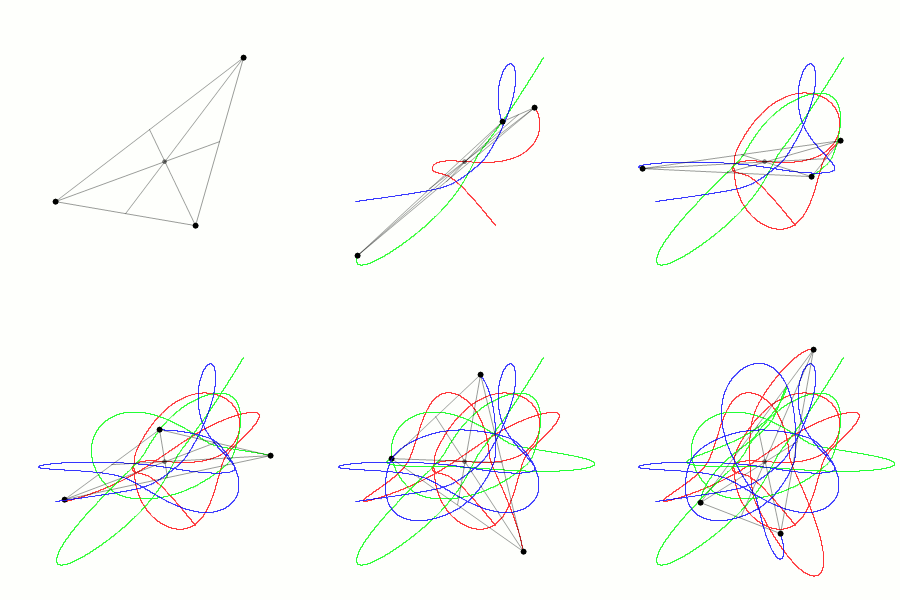
General solution
PThere is no general closed-form solution to the three-body problem.[1] In other words, it does not have a general solution that can be expressed in terms of a finite number of standard mathematical operations. Moreover, the motion of three bodies is generally non-repeating, except in special cases.[8] However, in 1912 the Finnish mathematician Karl Fritiof Sundman proved that there exists an analytic solution to the three-body problem in the form of a Puiseux series, specifically a power series in terms of powers of t1/3.[9] This series converges for all real t, except for initial conditions corresponding to zero angular momentum. In practice, the latter restriction is insignificant since initial conditions with zero angular momentum are rare, having Lebesgue measure zero. An important issue in proving this result is the fact that the radius of convergence for this series is determined by the distance to the nearest singularity. Therefore, it is necessary to study the possible singularities of the three-body problems. As is briefly discussed below, the only singularities in the three-body problem are binary collisions (collisions between two particles at an instant) and triple collisions (collisions between three particles at an instant).
